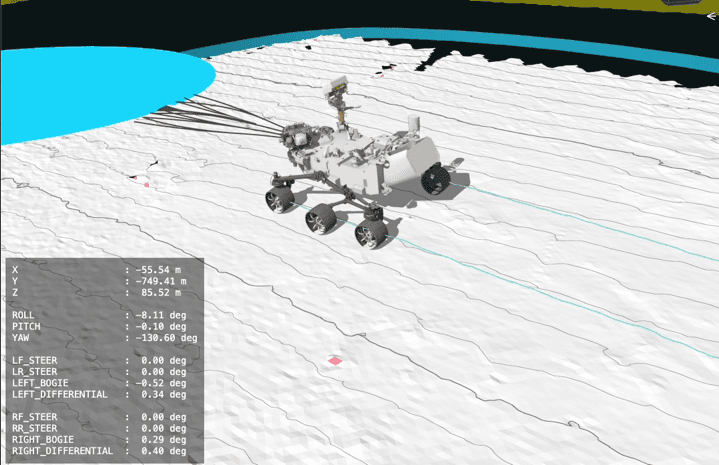
The historic drives took place on December 8 and 10, 2025, along the rim of Mars' Jezero Crater. Over two days, Perseverance traveled a combined 1,496 feet (456 meters), with AI making real-time navigation decisions based on terrain analysis and obstacle avoidance algorithms.
NASA collaborated with Anthropic to implement Claude AI models in the rover's onboard systems, enabling the vehicle to analyze navigation camera imagery, assess terrain conditions, and plot optimal paths autonomously. The AI processed data in real-time to navigate around rocks, craters, and other hazards.
"This represents a fundamental shift in how we explore other worlds," said mission engineers at JPL's Rover Operations Center. "Instead of waiting hours for commands from Earth, Perseverance can now make intelligent decisions on its own, dramatically increasing our exploration efficiency."
NASA released stunning visualizations created with the Caspian tool, showing pale blue lines depicting the rover's wheel tracks and black lines representing different path options the AI considered moment-to-moment. The animations provide unprecedented insight into the rover's decision-making process.